Special Report · October 2026
Why AI Data Center Construction Keeps Failing
The buildout is failing at delivery, not demand. Five constraints (power, permits, parts, people and paper) now share one critical path.
Compute Terminal Research · Data as of 23 October 2026 · 33-page print edition · 56 sources
Free with a Compute Terminal account. Visitors are asked to sign in or create a free account first, then come straight back.
Key findings
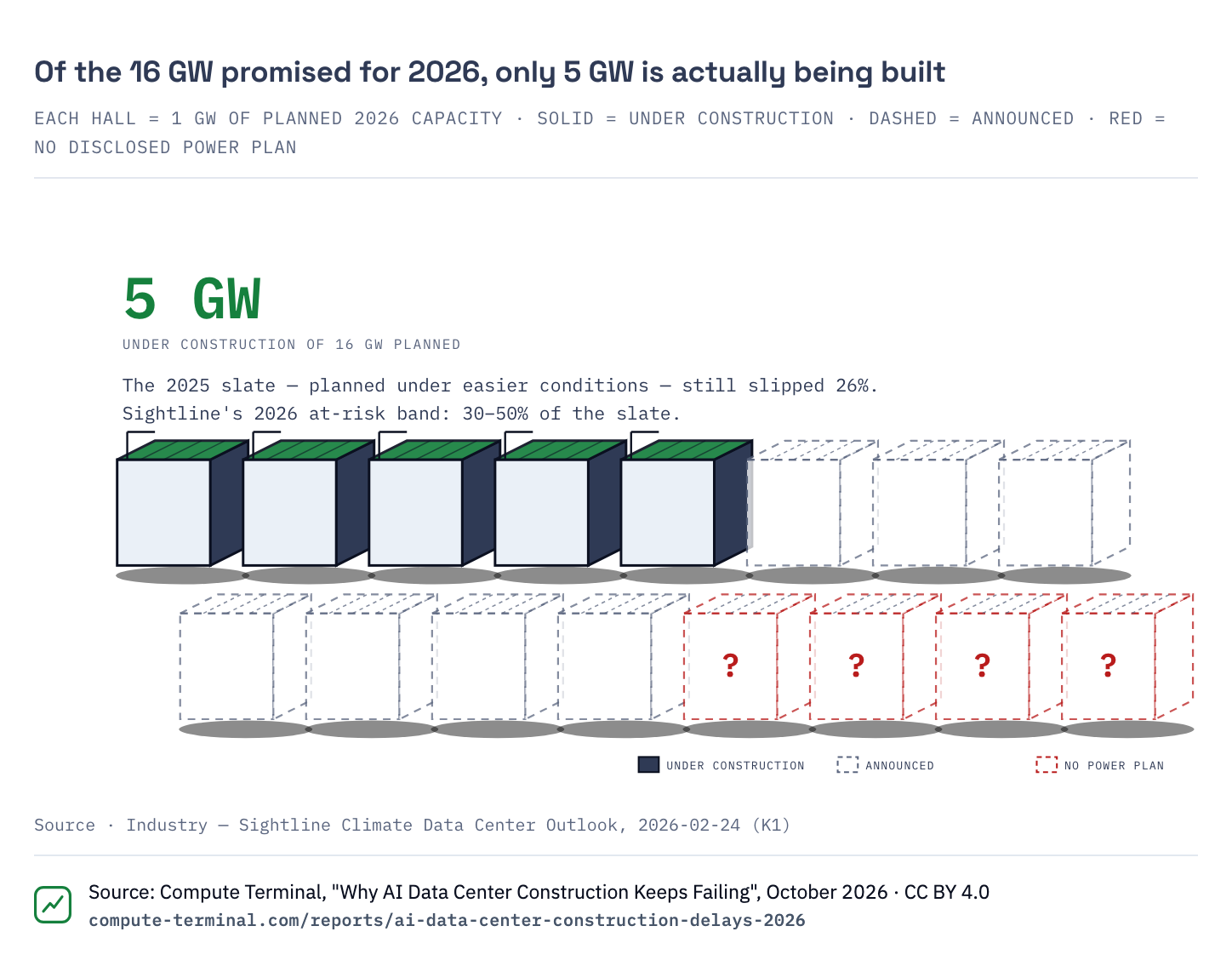
- Sightline Climate expects 30–50% of the large AI datacentres planned for 2026 to be delayed, after 26% of the 110 large projects due in 2025 slipped.
- Demand is not the constraint: North American primary-market vacancy is a record-low 1.4%, and 80.4% of the record 7,481 MW under construction is pre-leased (H1 2026).
- Of roughly 16 GW of large-scale capacity announced to come online globally in 2026, only about 5 GW is under construction.
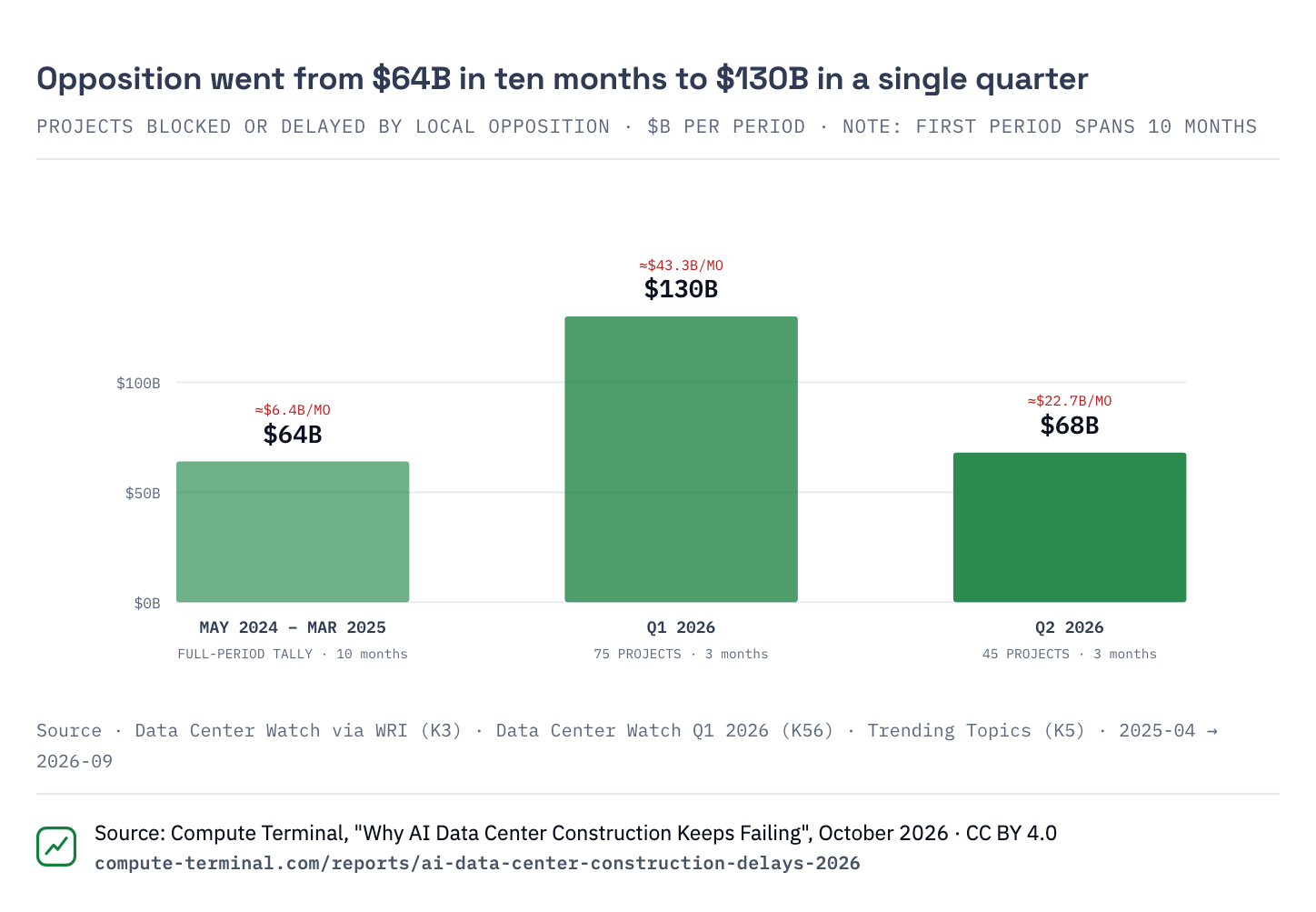
- Consent is now the scarcest input: 90 local moratoria have passed, and Data Center Watch counts about US$198bn of projects blocked or delayed in the first half of 2026.
- Delay is expensive: a representative 60 MW build loses about US$14.2m for every month of delay, and a six-month slip cuts project IRR from 17.1% to 8.8%.
Sources: Sightline Climate (K1), CBRE H1 2026 (K30), Data Center Watch Q1 and Q2 2026 (K56, K5), the DIGSLab/AAAS policy tracker (K18) and the STL Partners delay-cost model (K6), as listed in the report's source register.
Exhibits
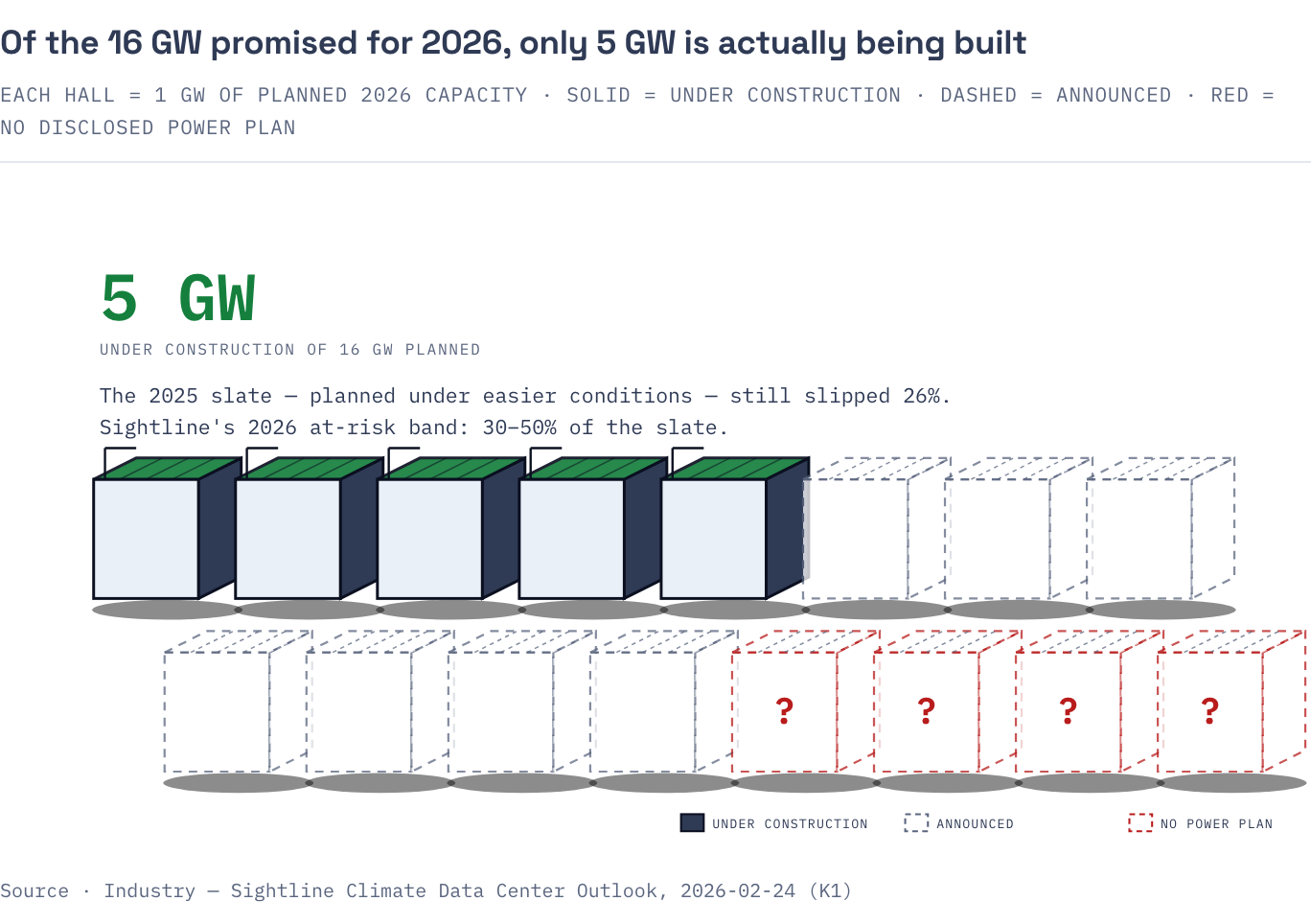
Free to reuse under CC BY 4.0 with the credit “Source: Compute Terminal” and a link back. The PNG and the embed carry both.
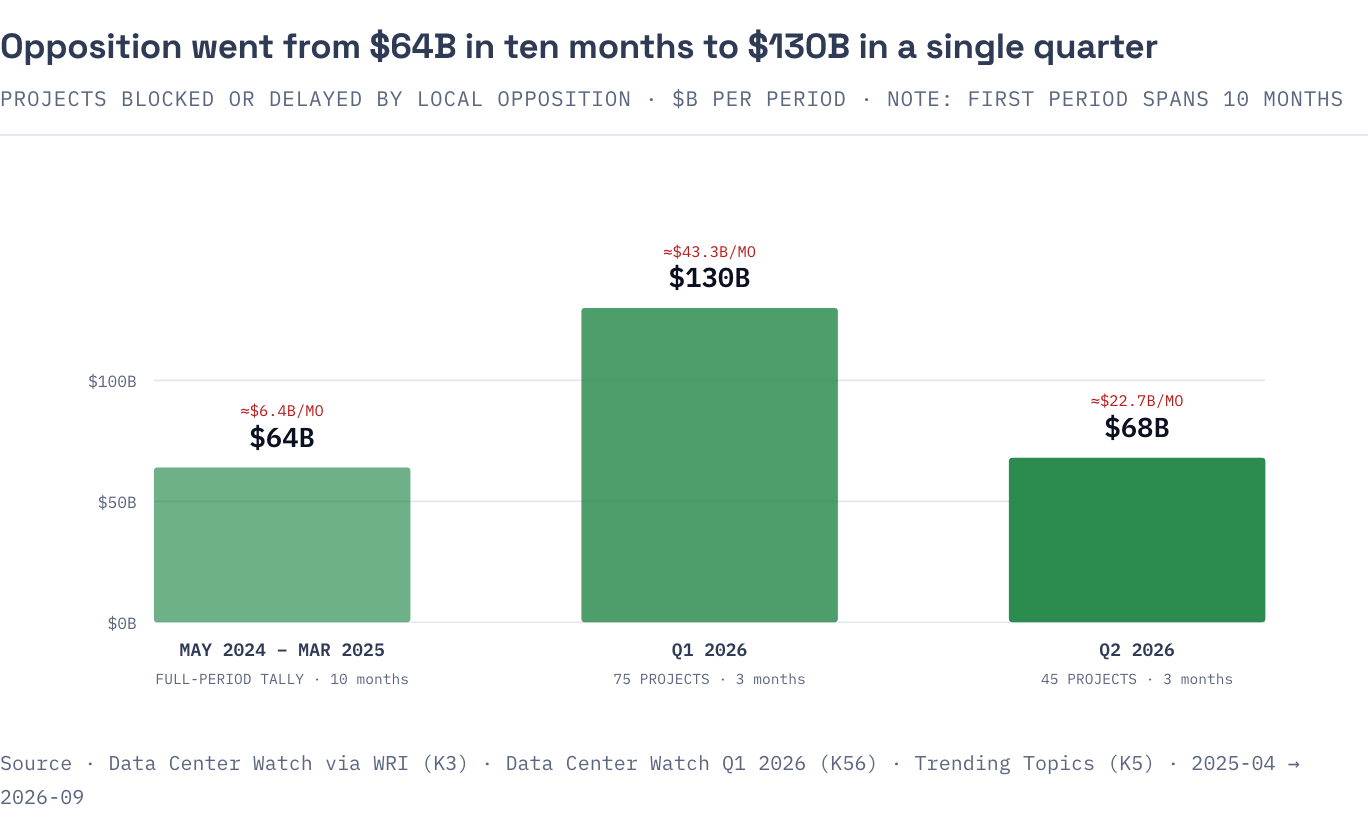
Free to reuse under CC BY 4.0 with the credit “Source: Compute Terminal” and a link back. The PNG and the embed carry both.
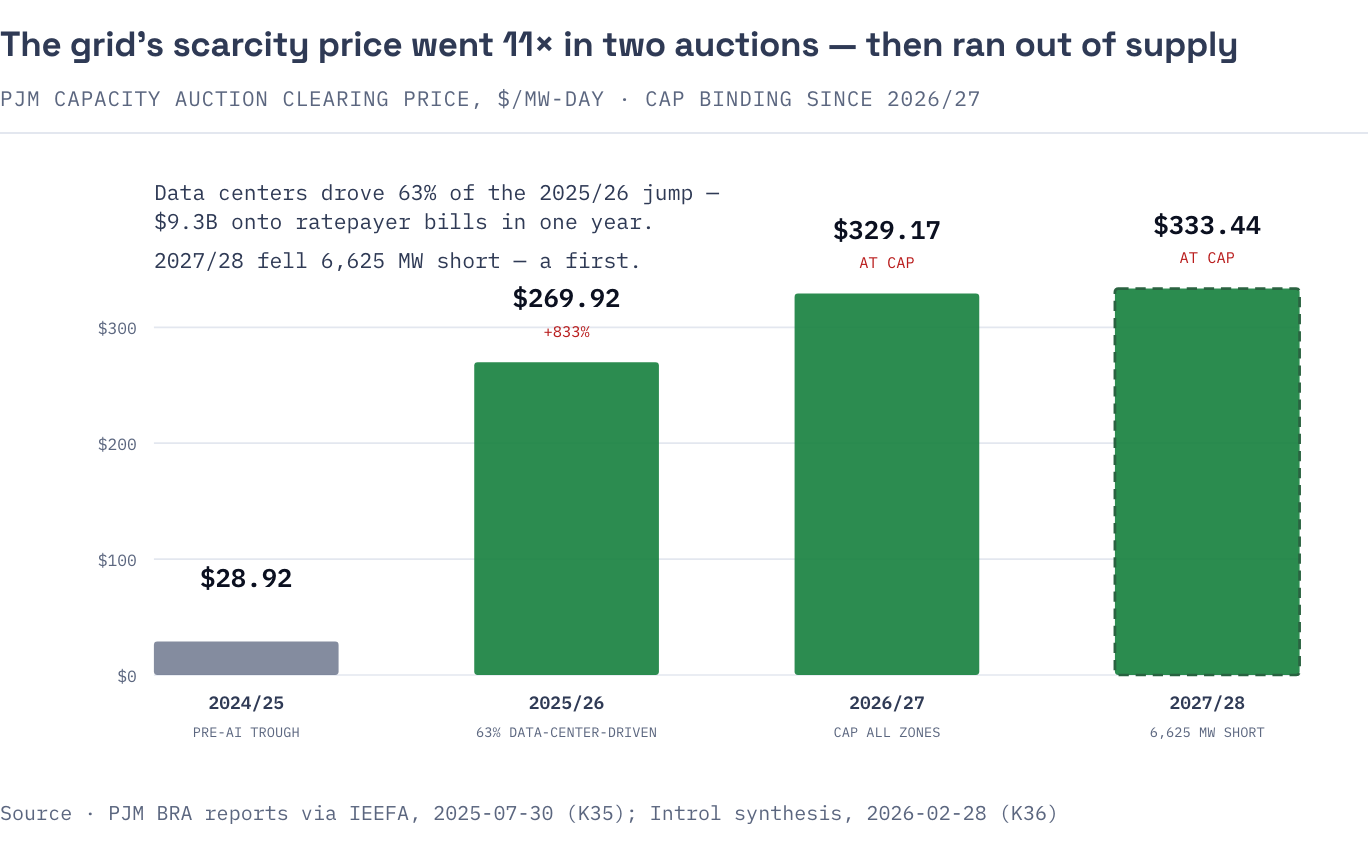
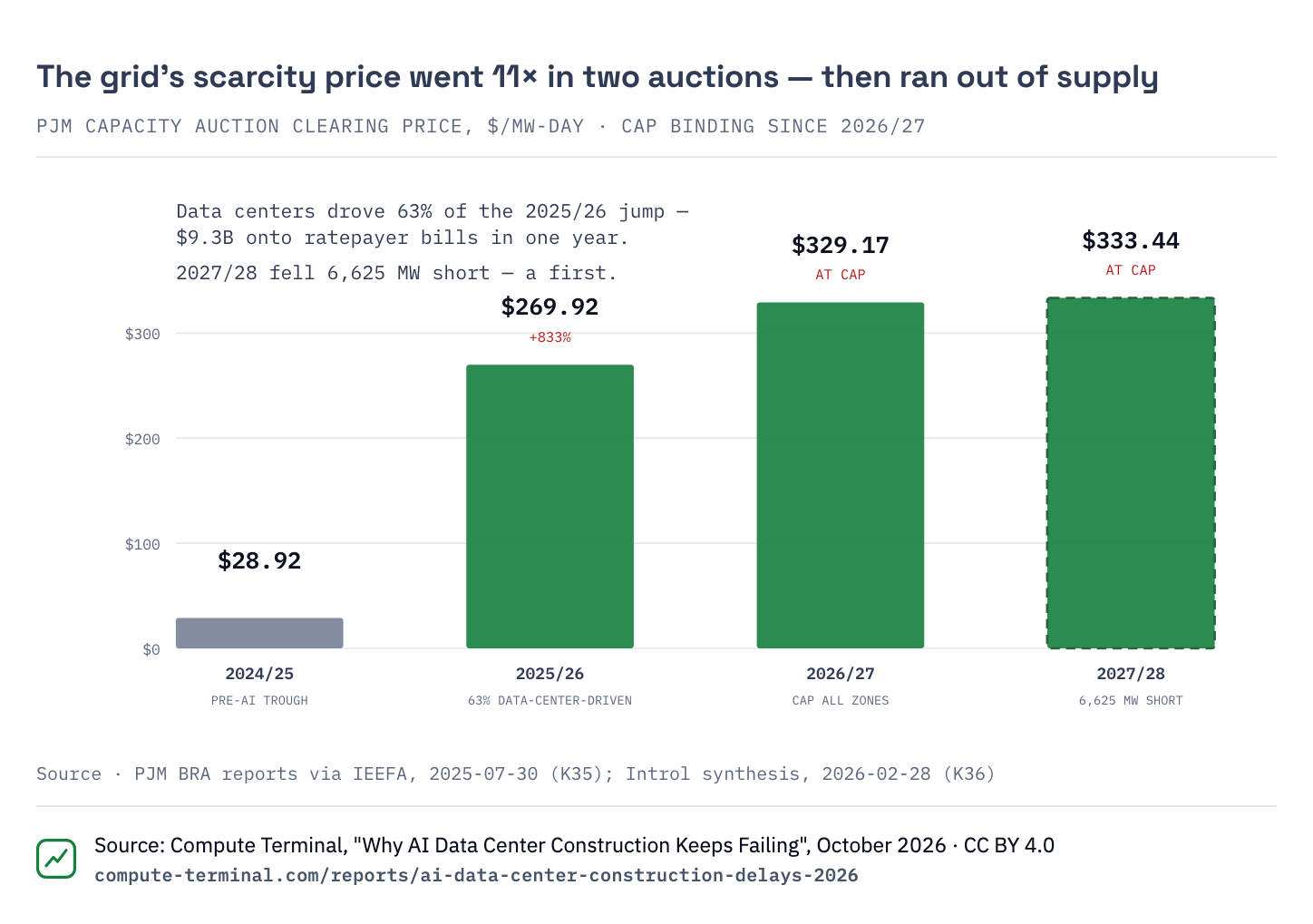
Free to reuse under CC BY 4.0 with the credit “Source: Compute Terminal” and a link back. The PNG and the embed carry both.
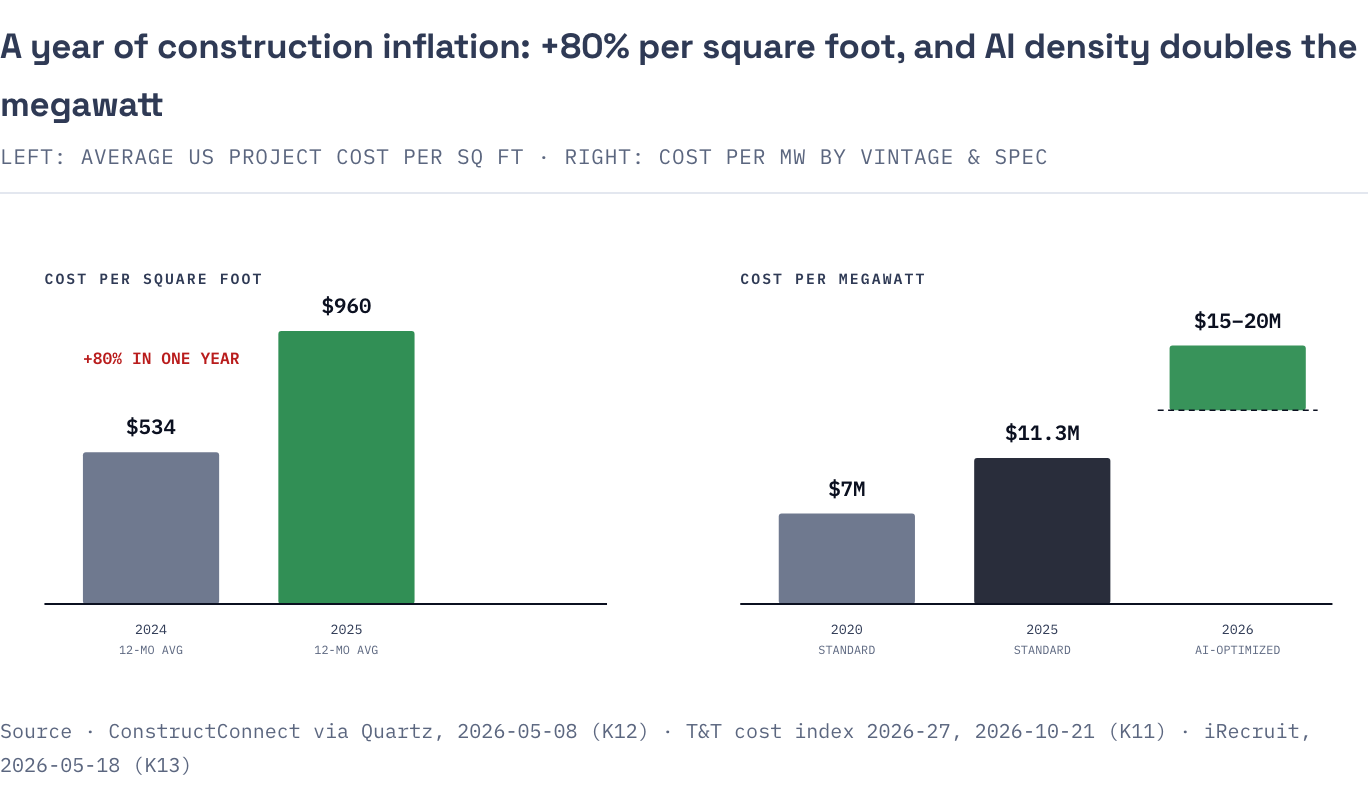
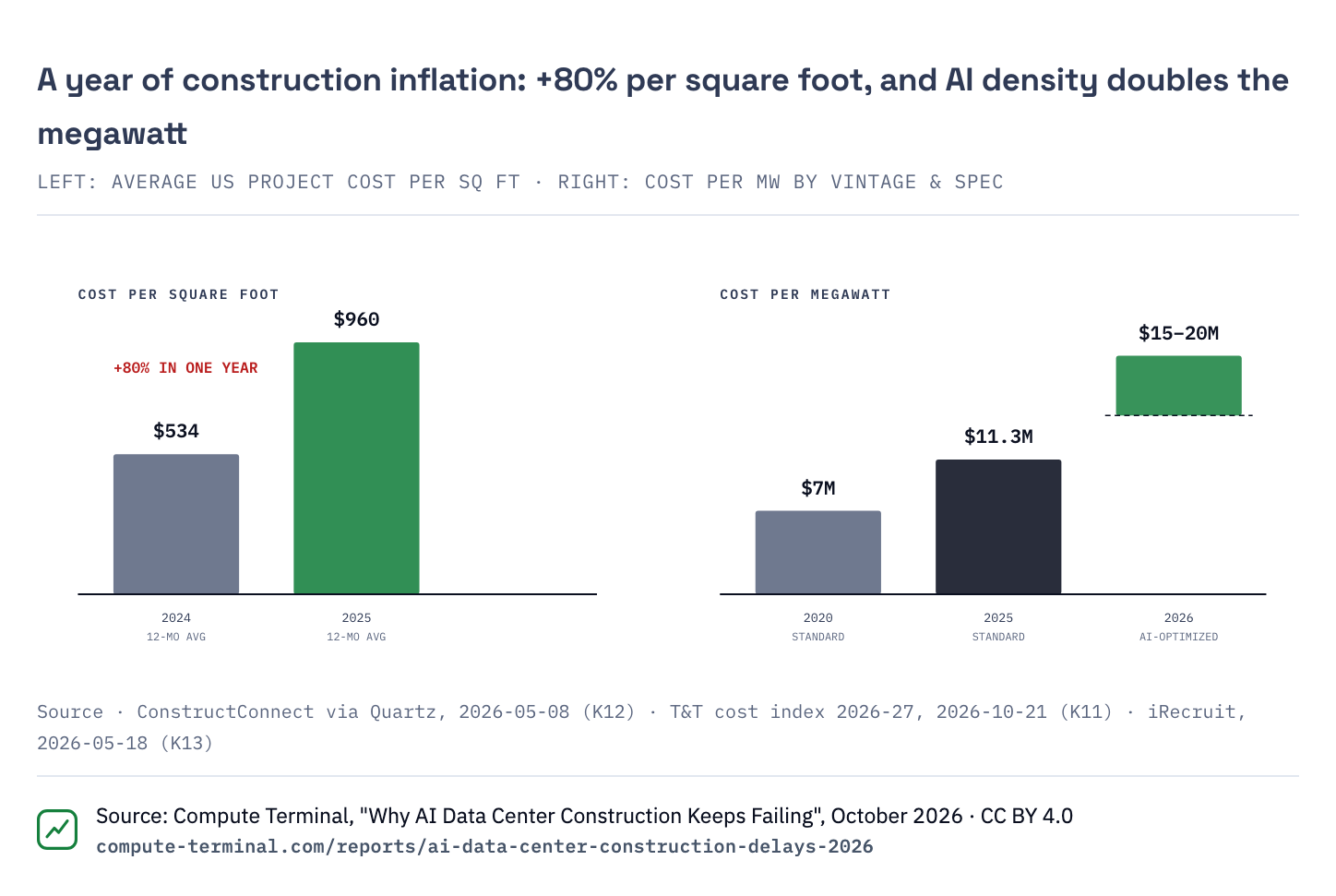
Free to reuse under CC BY 4.0 with the credit “Source: Compute Terminal” and a link back. The PNG and the embed carry both.
Contents
Compute Open
- §0 Key findings: the bottleneck is not demand, chips or capital; it is the building itself
- §1 The scoreboard: a third to a half of this year's slate is expected to miss
- §2 The record: two years of failure, dated
- §3 Gate 1, Power: a five-year queue, half of it phantom, sets the schedule
- §4 Gate 2, Consent: ninety moratoria and counting
- §5 Gate 3, Money: costs, crews and debt priced for failure
- §6 Gate 4, The building: 100 kW racks, liquid loops and commissioning
- §7 What breaks next: five propositions for 2027, graded by likelihood
- §8 The verdict: cyclical pruning or structural failure?
- Source register: K1–K56, with dates and links
Method and sources
Every figure in the report carries a K-anchor to a dated source in the register at the end (K1–K56). Company disclosures and regulatory data rank first; cross-checked journalism and broker research second; industry trackers, compilations and commentary third, always dated and graded. Forecasts are marked as forecasts and analyst judgements as judgements. Corrections are logged at /corrections; how we research is at /methodology.
Questions
Why are AI datacentres being delayed?
Because five constraints now sit on the same critical path: power (five-year interconnection queues and 160-week transformer lead times), permits (local moratoria and organised opposition), parts, people (a construction workforce about 439,000 workers short) and paper (financing priced for on-time delivery). Demand is not the problem: vacancy is a record-low 1.4%.
How many AI datacentre projects will be delayed in 2026?
Sightline Climate, which tracks announced projects above 50 MW, expects 30–50% of the large AI datacentres planned for 2026 to be delayed. In 2025, 26% of the 110 large projects due that year slipped. Outright cancellations are rarer: nine have been tallied.
What does a month of delay cost?
For a representative 60 MW AI build, about US$14.2m a month in lost revenue, labour and overhead, and SLA penalties. A six-month slip cuts project IRR from 17.1% to 8.8%, below most institutional hurdle rates.
How many local moratoria are there on datacentres?
At least 136 have been proposed and 90 have passed, with 22 outright bans proposed or passed; fourteen state legislatures have considered statewide pauses. Data Center Watch counts about US$198bn of projects blocked or delayed in the first half of 2026.
Is the report free?
Yes. The full interactive edition and the 33-page print edition are free with a Compute Terminal account. Each PDF is licensed to the reader and stamped with their address.
How current is the data?
Data as of 23 October 2026. The report is a dated publication; figures are not updated after publication, and any correction is logged at /corrections.
Related
Impersonal, general research for professional market participants, including professional and sophisticated investors where receipt of such research is lawful. Not investment, procurement, engineering, legal or tax advice, and not a recommendation to buy or sell any security.
Research for information only. Not investment advice. Compute Terminal is subscriber-funded and publishes the same calls to every tier at the same time.
Compute Terminal Research. No ratings and no price targets. Conflicts and disclosure policy: /policy.
Compute Terminal Research · Published 31 Oct 2026 · Data as of 23 Oct 2026