Explainer · AI Infrastructure Primer 2026
What is a neocloud?
$4.50
Compute Terminal Public Rate Card CompositeAs of 14 Oct 2026Source$10.00
Compute Terminal Public Rate Card CompositeAs of 14 Oct 2026SourceDefinition and origin
A neocloud is a cloud provider built around one product: large, tightly networked pools of the latest AI accelerators, rentable with minimal friction. Where a hyperscaler offers hundreds of services and treats GPUs as one line item, the neocloud treats the GPU cluster as the entire company — procurement, datacentre design, cluster software and sales are all optimised for accelerated computing. The category emerged in 2022–23 when three forces collided: demand for H100-class compute exploded after ChatGPT; hyperscalers' internal needs crowded out external customers; and NVIDIA — keen to diversify its channel — allocated supply to, and even invested in, independent operators. Crypto-era companies with power assets (CoreWeave, Crusoe, Applied Digital, Iris Energy/IREN, Hut 8) pivoted fastest, because they already controlled the scarcest input: energised sites.
The moat, such as it is, sits in three places. First, access: allocation relationships with NVIDIA and its ODMs, and increasingly with power utilities. Second, speed: the ability to take a signed contract to live, accepted GPUs in months rather than years. Third, operational quality: delivering clusters that stay up and train fast, which at frontier scale is a genuine engineering discipline. None of these is software-style defensible; all of them compound with scale and reputation.
Market size and shape
The physical build-out is even easier to see. CoreWeave reported Q2 2026 revenue of $2.6bn (+112% y/y), 1.5 GW of active power and 4.2 GW contracted by 11 August, and a revenue backlog of ~$104bn — before more than $25bn of net new commitments signed early in Q3; it guides 2026 capex to $35–39bn. Nebius reported Q2 revenue of $582m (+454% y/y) and $3.0bn of annualised run-rate revenue, reaffirmed 2026 guidance for $7–9bn of exit ARR on $20–25bn of capex, and targets 5 GW of contracted power by the end of 2026. Nscale's NYSE registration (18 September) disclosed $103.4bn of contracted value at 31 August and ~461,000 GPUs active or contracted; Crusoe reports more than $140bn of contracted value and more than 6 GW of contracted capacity, 1 GW of it operating. These are utility-scale numbers wearing cloud accounting.
Demand concentrates heavily. The anchor tenants are frontier labs and hyperscalers buying multi-year, multi-billion-dollar blocks: Microsoft–Nebius ($17.4bn, expandable to $19.4bn), Meta–Nebius (~$27bn over five years), Meta–CoreWeave (an order form of up to ~$21bn running to December 2032), Microsoft–IREN (~$9.7bn over five years), and Anthropic's commitments to Nscale (~$45bn, per The Information, September 2026) and Fluidstack (a multi-gigawatt US build-out announced at ~$50bn, Jul 2026). A second tier — AI-native start-ups, enterprises, quant firms and sovereign programmes — pays higher unit prices on shorter terms and is the margin kicker; the long-dated anchor contracts are what make the debt financeable.
Three business archetypes
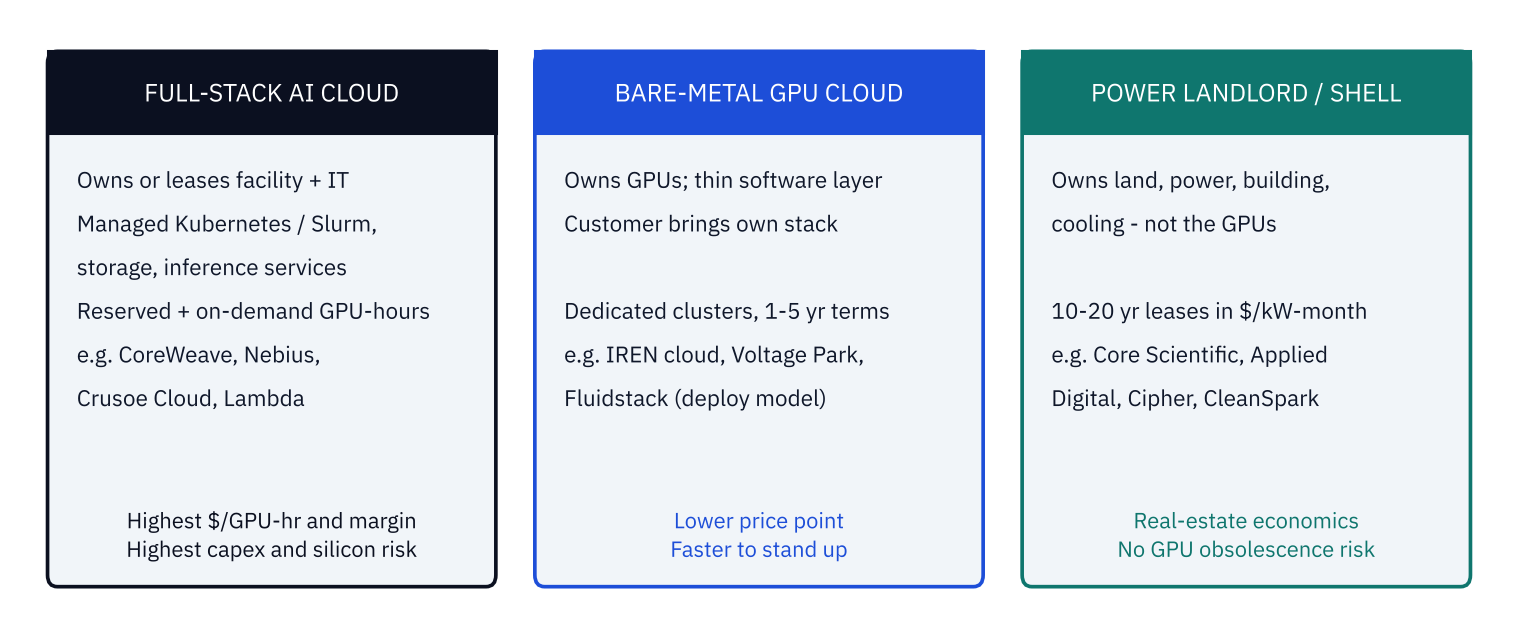
Source: Compute Terminal analysis of company disclosures, October 2026.
Full-stack AI clouds (CoreWeave, Nebius, Crusoe Cloud, Lambda) own or lease the facility and the IT, and wrap it in managed Kubernetes/Slurm, storage, observability and inference services. They capture the highest $/GPU-hour and the stickiest workloads, at the cost of carrying both facility and silicon risk. Bare-metal providers (IREN's cloud segment, Voltage Park, Fluidstack's deployment model) sell dedicated clusters with a thin software layer — faster to stand up, lower price points, customers bring their own stack. Power landlords (Core Scientific, Applied Digital, Cipher, TeraWulf, CleanSpark) monetise the scarcest layer — energised shells — through 10–20-year leases priced in $/kW-month, taking real-estate economics and no GPU obsolescence risk. CleanSpark's 20-year, $6.6bn, 175 MW lease in Georgia (ready late 2027) works out at roughly $1.9m per MW per year, or ~$157 per kW-month (author arithmetic) — an order of magnitude below GPU-capacity contracts, because the tenant buys the hardware. The 2025–26 wave of hyperscaler leases shows how much value has migrated to whoever holds the electrons.
Unit economics in one paragraph
A GB300-class megawatt costs roughly $45–55m all-in to stand up (author estimate, Jul 2026). Sold on a 2025-vintage long-dated hyperscaler contract — IREN–Microsoft works out at ~$9.7m per MW per year — that implies a ~4–5-year gross payback before opex and interest. Sold at 2026 terms of ~$20–25m per MW per year (Nebius's four large Q2 deals; IREN's recent three-year contracts), gross payback falls to roughly two to two-and-a-half years; Nebius puts payback on its Q2 deals at one year ten months, helped by prepayments that cover 50–60% of the associated capex. Short-dated (3–6-month) capacity has cleared at ~$40m per MW at CoreWeave and $40–50m at Nebius. Adjusted-EBITDA margins flatter the picture because depreciation is the business: the true economic question is whether contracted cash flows repay the silicon before the next architecture reprices it, and what the asset earns when it is re-contracted. This is why contract cover matters more than any other metric, and why the market treated CoreWeave's March 2026 milestone — the first investment-grade-rated, $8.5bn GPU-backed loan — as a category event: it moved the marginal cost of capital for the whole sector.
From the AI Infrastructure Primer 2026, October 2026 edition, data as of 14 October 2026: Chapter 1, The neocloud sector. Reproduced in the Primer's own words; passages citing third-party price indices are left out here and kept in the full edition.
What neoclouds charge today
| GPU | Neocloud | Hyperscaler (list) | Marketplace |
|---|---|---|---|
| NVIDIA H100 | $4.50Compute Terminal Public Rate Card CompositeAs of 14 Oct 2026Source | $10.00Compute Terminal Public Rate Card CompositeAs of 14 Oct 2026Source | $2.14Compute Terminal Public Rate Card CompositeAs of 14 Oct 2026Source |
| NVIDIA H200 | $5.40Compute Terminal Public Rate Card CompositeAs of 14 Oct 2026Source | $8.96Compute Terminal Public Rate Card CompositeAs of 14 Oct 2026Source | $3.64Compute Terminal Public Rate Card CompositeAs of 14 Oct 2026Source |
| NVIDIA B200 | $8.55Compute Terminal Public Rate Card CompositeAs of 14 Oct 2026Source | $14.12Compute Terminal Public Rate Card CompositeAs of 14 Oct 2026Source | $6.12Compute Terminal Public Rate Card CompositeAs of 14 Oct 2026Source |
| NVIDIA B300 | $9.50Compute Terminal Public Rate Card CompositeAs of 14 Oct 2026Source | $16.40Compute Terminal Public Rate Card CompositeAs of 14 Oct 2026Source | $6.94Compute Terminal Public Rate Card CompositeAs of 14 Oct 2026Source |
| AMD MI300X | $3.45Compute Terminal Public Rate Card CompositeAs of 14 Oct 2026Source | $6.00Compute Terminal Public Rate Card CompositeAs of 14 Oct 2026Source | $2.39Compute Terminal Public Rate Card CompositeAs of 14 Oct 2026Source |
Source: Compute Terminal Public Rate Card Composite, print of 14 Oct 2026. Hyperscaler figures are list prices before discounts.
Questions
What is a neocloud?
A neocloud is a cloud provider built around one product: large, tightly networked pools of the latest AI accelerators, rentable with minimal friction. Where a hyperscaler offers hundreds of services and treats GPUs as one line item, the neocloud treats the GPU cluster as the entire company — procurement, datacentre design, cluster software and sales are all optimised for accelerated computing.
How is a neocloud different from a hyperscaler?
Where a hyperscaler offers hundreds of services and treats GPUs as one line item, the neocloud treats the GPU cluster as the entire company — procurement, datacentre design, cluster software and sales are all optimised for accelerated computing.
What are the main neocloud business models?
Full-stack AI clouds (CoreWeave, Nebius, Crusoe Cloud, Lambda) own or lease the facility and the IT, and wrap it in managed Kubernetes/Slurm, storage, observability and inference services. They capture the highest $/GPU-hour and the stickiest workloads, at the cost of carrying both facility and silicon risk. Bare-metal providers (IREN's cloud segment, Voltage Park, Fluidstack's deployment model) sell dedicated clusters with a thin software layer — faster to stand up, lower price points, customers bring their own stack.
How do neoclouds make money?
A GB300-class megawatt costs roughly $45–55m all-in to stand up (author estimate, Jul 2026). Sold on a 2025-vintage long-dated hyperscaler contract — IREN–Microsoft works out at ~$9.7m per MW per year — that implies a ~4–5-year gross payback before opex and interest.
Where does a neocloud's advantage come from?
The moat, such as it is, sits in three places. First, access: allocation relationships with NVIDIA and its ODMs, and increasingly with power utilities. Second, speed: the ability to take a signed contract to live, accepted GPUs in months rather than years. Third, operational quality: delivering clusters that stay up and train fast, which at frontier scale is a genuine engineering discipline.
Updated 14 Oct 2026. Text: AI Infrastructure Primer 2026, data as of 14 October 2026. Live figures: Compute Terminal stored data. Methodology: AI Infrastructure Primer 2026. Not investment advice.
The full 70-page Primer is free with Compute Open: get the AI Infrastructure Primer 2026 →
Free · every trading day · 08:00 ET