Explainer · AI Infrastructure Primer 2026
GPU-hour economics: what a GPU earns and costs
$4.50
Compute Terminal Public Rate Card CompositeAs of 14 Oct 2026SourceUnit economics in one paragraph
A GB300-class megawatt costs roughly $45–55m all-in to stand up (author estimate, Jul 2026). Sold on a 2025-vintage long-dated hyperscaler contract — IREN–Microsoft works out at ~$9.7m per MW per year — that implies a ~4–5-year gross payback before opex and interest. Sold at 2026 terms of ~$20–25m per MW per year (Nebius's four large Q2 deals; IREN's recent three-year contracts), gross payback falls to roughly two to two-and-a-half years; Nebius puts payback on its Q2 deals at one year ten months, helped by prepayments that cover 50–60% of the associated capex. Short-dated (3–6-month) capacity has cleared at ~$40m per MW at CoreWeave and $40–50m at Nebius. Adjusted-EBITDA margins flatter the picture because depreciation is the business: the true economic question is whether contracted cash flows repay the silicon before the next architecture reprices it, and what the asset earns when it is re-contracted. This is why contract cover matters more than any other metric, and why the market treated CoreWeave's March 2026 milestone — the first investment-grade-rated, $8.5bn GPU-backed loan — as a category event: it moved the marginal cost of capital for the whole sector.
Pricing, supply and the October 2026 state of play
The supply arc continues regardless. Blackwell Ultra (GB300) drove NVIDIA's Q2 FY2027 ramp, and Vera Rubin began production shipments in August 2026, with racks running at CoreWeave, Google Cloud, Azure, OCI and Nebius. Operators must therefore decide whether to buy the end of one curve or the start of the next — and every Rubin rack eventually lowers the clearing price of the H100 hour.
Competitive structure is also shifting above the neoclouds. On 1 July 2026 Meta launched Meta Compute, renting slices of its own build-out — a signal that hyperscalers may become sellers as well as buyers of the same capacity; CoreWeave and Nebius fell 13–15% on the announcement. The bull read: it validates the rental model, and Meta still leases from neoclouds where it lacks sites. The bear read: the largest buyers can toggle to competitors whenever internal demand dips, which caps long-run pricing power for undifferentiated capacity. Either way, the episode reinforced the sector's core lesson — durable value accrues to contracted power, deployment speed and operational excellence, not to merely owning GPUs.
Where the capex goes
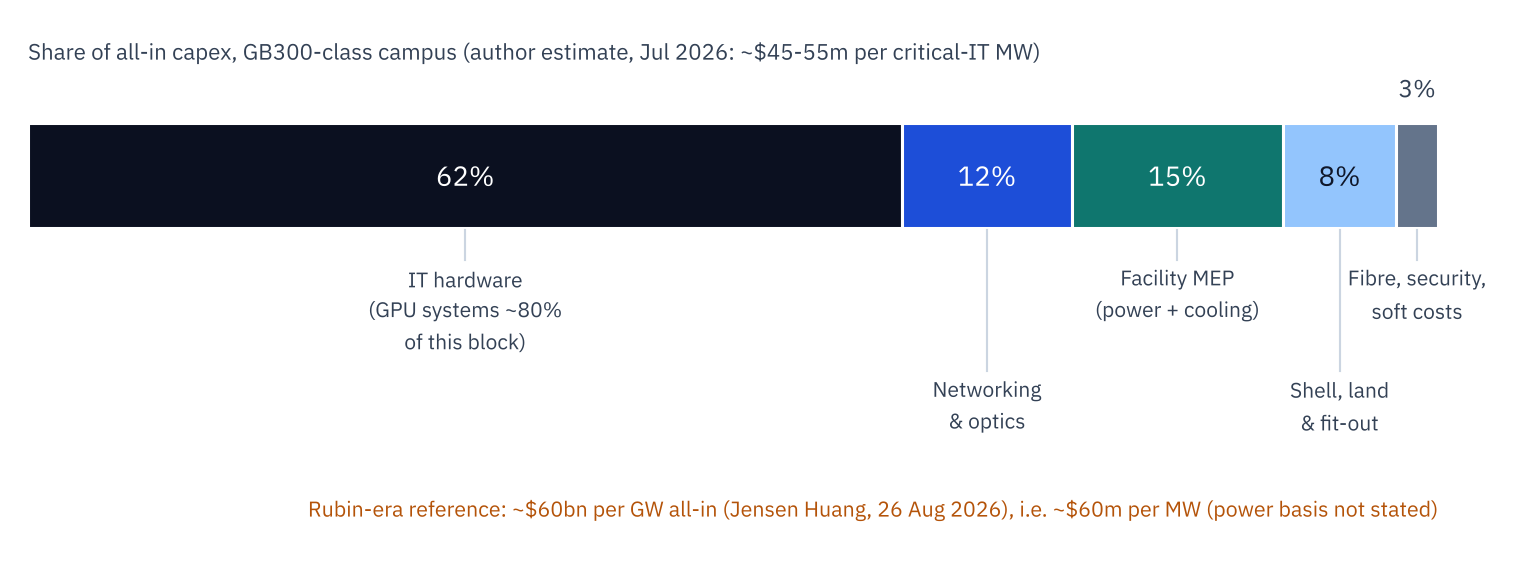
Source: author estimate (Jul 2026) for the GB300-class mix and per-MW range; Jensen Huang, NVIDIA Q2 FY2027 earnings call (26 Aug 2026), for ~$60bn per GW. Illustrative: IT refreshes every 3–5 years; facility and shell amortise over 15–30 years.
Two honest metrics
A cluster's commercial output is not its nameplate FLOPs. Two ratios describe reality. Goodput is the share of wall-clock time that does useful, non-repeated work: what survives after failures, restarts, checkpoint overhead and scheduling gaps. Model FLOPs Utilisation (MFU) is stricter. It is the share of theoretical peak FLOPs that becomes actual model mathematics, additionally discounting communication stalls, memory-bandwidth waits and imperfect kernels. World-class frontier training achieves ~90%+ goodput and ~38–43% MFU on Hopper-class BF16. Even excellent operators therefore convert well under half of the silicon they bought into sellable mathematics. Closing that gap is what operators sell.
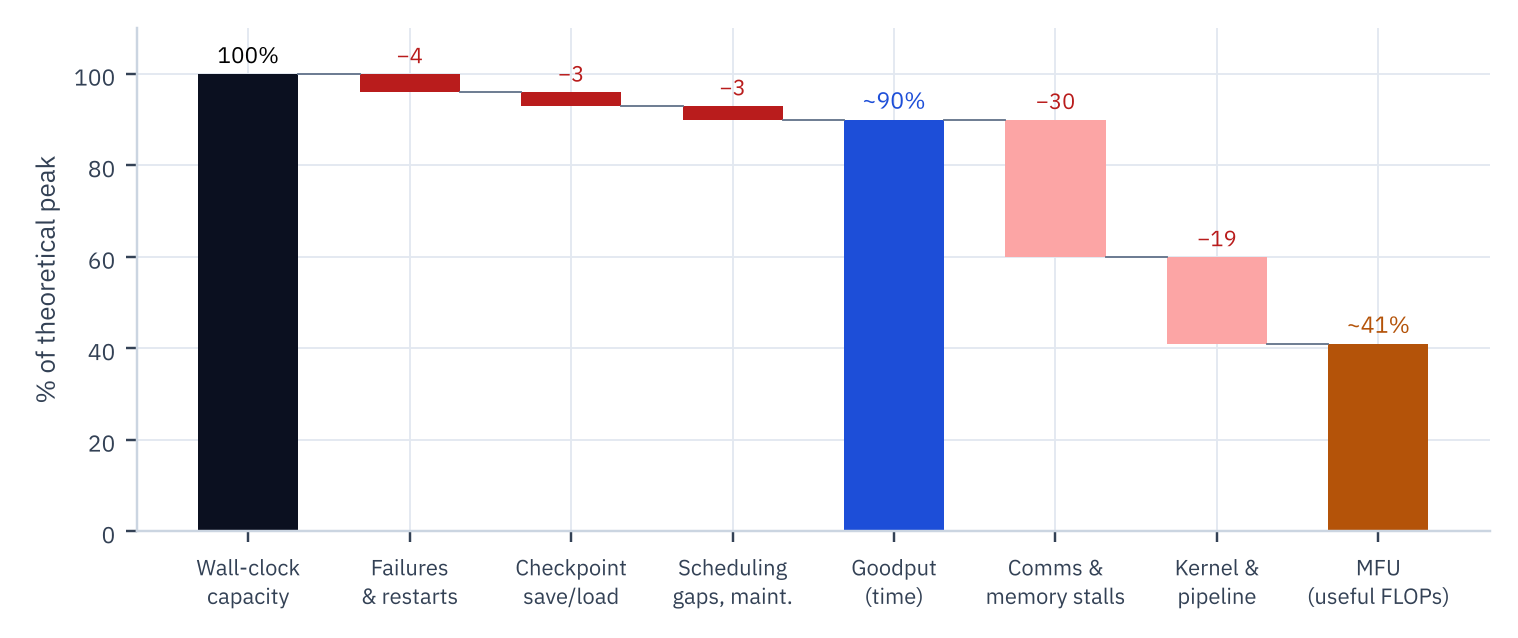
Source: Compute Terminal illustrative decomposition (author estimate), calibrated to published frontier runs (Meta Llama 3 405B: BF16 MFU 38–43%, >90% effective training time on 16,384 H100s). Larger NVLink domains and FP4/FP8 shift achievable MFU on Blackwell-class systems.
From the AI Infrastructure Primer 2026, October 2026 edition, data as of 14 October 2026: Chapter 1, The neocloud sector; Chapter 5, The value chain; Chapter 10, GPU productivity: installed is not productive. Reproduced in the Primer's own words; passages citing third-party price indices are left out here and kept in the full edition.
Today's on-demand prices, converted per megawatt
| GPU | $/GPU-hour | GPUs per MW | $m per MW-year | $/kW-month |
|---|---|---|---|---|
| NVIDIA H100 | $4.50Compute Terminal Public Rate Card CompositeAs of 14 Oct 2026Source | 700 | $27.6m | $2,300 |
| NVIDIA B200 | $8.55Compute Terminal Public Rate Card CompositeAs of 14 Oct 2026Source | 520 | $38.9m | $3,246 |
| NVIDIA B300 | $9.50Compute Terminal Public Rate Card CompositeAs of 14 Oct 2026Source | 520 | $43.3m | $3,606 |
Prices: Compute Terminal Public Rate Card Composite, neocloud on-demand, print of 14 Oct 2026. Conversion at full utilisation with the Compute Price Converter's formula and density estimates (calculated). Try other prices and utilisation in the converter.
Questions
How much does it cost to build an AI datacentre per megawatt?
A GB300-class megawatt costs roughly $45–55m all-in to stand up (author estimate, Jul 2026).
How long does a GPU cluster take to pay back?
Sold on a 2025-vintage long-dated hyperscaler contract — IREN–Microsoft works out at ~$9.7m per MW per year — that implies a ~4–5-year gross payback before opex and interest. Sold at 2026 terms of ~$20–25m per MW per year (Nebius's four large Q2 deals; IREN's recent three-year contracts), gross payback falls to roughly two to two-and-a-half years; Nebius puts payback on its Q2 deals at one year ten months, helped by prepayments that cover 50–60% of the associated capex.
What is goodput?
Goodput is the share of wall-clock time that does useful, non-repeated work: what survives after failures, restarts, checkpoint overhead and scheduling gaps. Model FLOPs Utilisation (MFU) is stricter.
Updated 14 Oct 2026. Text: AI Infrastructure Primer 2026, data as of 14 October 2026. Live figures: Compute Terminal stored data. Methodology: AI Infrastructure Primer 2026. Not investment advice.
The full 70-page Primer is free with Compute Open: get the AI Infrastructure Primer 2026 →
Free · every trading day · 08:00 ET