Explainer · AI Infrastructure Primer 2026
From $/kW-month to $/GPU-hour
$4.50
Compute Terminal Public Rate Card CompositeAs of 14 Oct 2026SourceThree business archetypes
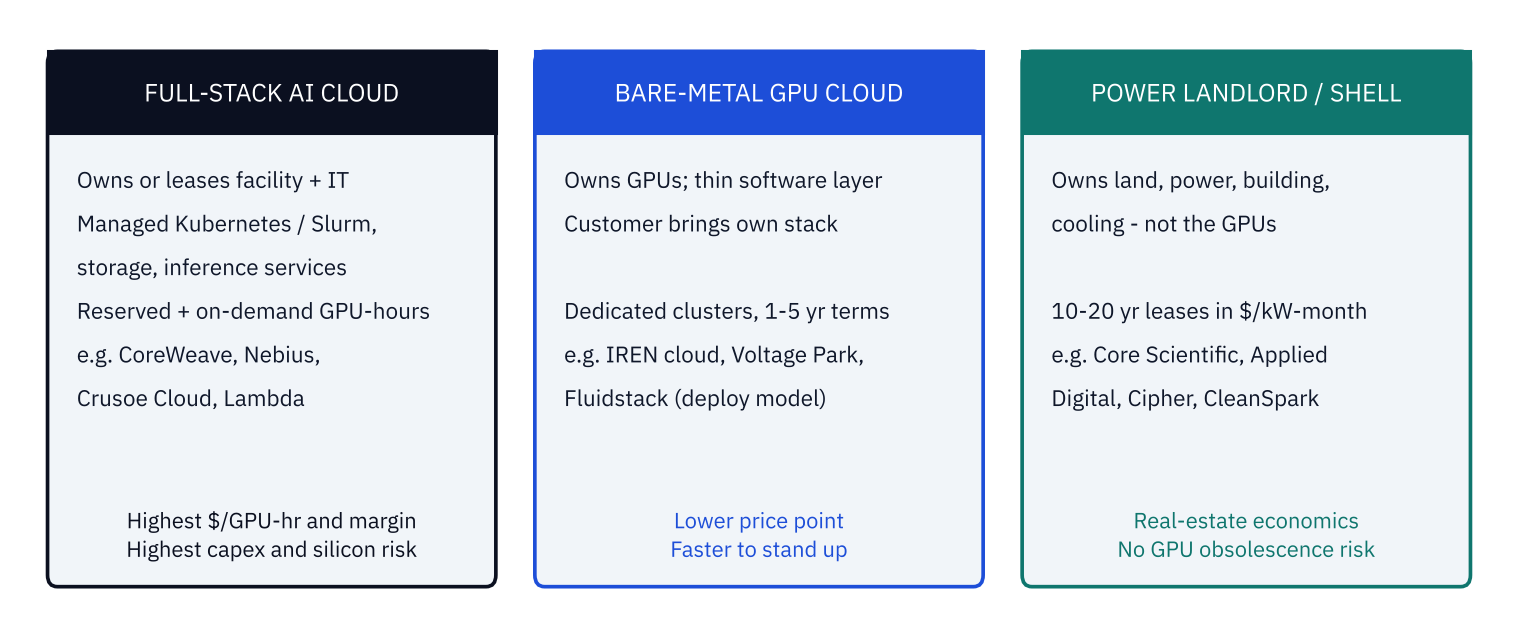
Source: Compute Terminal analysis of company disclosures, October 2026.
Full-stack AI clouds (CoreWeave, Nebius, Crusoe Cloud, Lambda) own or lease the facility and the IT, and wrap it in managed Kubernetes/Slurm, storage, observability and inference services. They capture the highest $/GPU-hour and the stickiest workloads, at the cost of carrying both facility and silicon risk. Bare-metal providers (IREN's cloud segment, Voltage Park, Fluidstack's deployment model) sell dedicated clusters with a thin software layer — faster to stand up, lower price points, customers bring their own stack. Power landlords (Core Scientific, Applied Digital, Cipher, TeraWulf, CleanSpark) monetise the scarcest layer — energised shells — through 10–20-year leases priced in $/kW-month, taking real-estate economics and no GPU obsolescence risk. CleanSpark's 20-year, $6.6bn, 175 MW lease in Georgia (ready late 2027) works out at roughly $1.9m per MW per year, or ~$157 per kW-month (author arithmetic) — an order of magnitude below GPU-capacity contracts, because the tenant buys the hardware. The 2025–26 wave of hyperscaler leases shows how much value has migrated to whoever holds the electrons.
Unit economics in one paragraph
A GB300-class megawatt costs roughly $45–55m all-in to stand up (author estimate, Jul 2026). Sold on a 2025-vintage long-dated hyperscaler contract — IREN–Microsoft works out at ~$9.7m per MW per year — that implies a ~4–5-year gross payback before opex and interest. Sold at 2026 terms of ~$20–25m per MW per year (Nebius's four large Q2 deals; IREN's recent three-year contracts), gross payback falls to roughly two to two-and-a-half years; Nebius puts payback on its Q2 deals at one year ten months, helped by prepayments that cover 50–60% of the associated capex. Short-dated (3–6-month) capacity has cleared at ~$40m per MW at CoreWeave and $40–50m at Nebius. Adjusted-EBITDA margins flatter the picture because depreciation is the business: the true economic question is whether contracted cash flows repay the silicon before the next architecture reprices it, and what the asset earns when it is re-contracted. This is why contract cover matters more than any other metric, and why the market treated CoreWeave's March 2026 milestone — the first investment-grade-rated, $8.5bn GPU-backed loan — as a category event: it moved the marginal cost of capital for the whole sector.
Worked arithmetic: from megawatts to tokens
- Revenue per MW, restated in tokens. At ~700 H100-class GPUs per MW of IT load (author estimate), 1,000–3,000 output tokens per second per GPU equates to roughly 22–66 trillion tokens per MW-year (author arithmetic) — the "nameplate output" of the factory. A 2026 contract at ~$20–25m per MW per year therefore prices that output at very roughly $0.3–1.1 per million tokens of capacity, before utilisation.
- Training and inference monetise differently. Training is sold as reserved capacity; inference is increasingly sold as tokens or as dedicated always-on halls. The same physical asset can serve both, but contract shape, network design and siting optimum differ.
- Token deflation is structural; GPU-hour pricing is cyclical. Each hardware generation cuts cost per token faster than it cuts $/GPU-hour, and multi-vendor silicon and hyperscaler surplus resale add downward pressure. 2026 showed that GPU-hour prices can rise for a year or more when demand outruns deliveries; underwriting should still assume token prices fall every year the asset operates.
From the AI Infrastructure Primer 2026, October 2026 edition, data as of 14 October 2026: Chapter 1, The neocloud sector; Chapter 2, The AI factory and token economics. Reproduced in the Primer's own words; passages citing third-party price indices are left out here and kept in the full edition.
Today's on-demand prices, converted per megawatt
| GPU | $/GPU-hour | GPUs per MW | $m per MW-year | $/kW-month |
|---|---|---|---|---|
| NVIDIA H100 | $4.50Compute Terminal Public Rate Card CompositeAs of 14 Oct 2026Source | 700 | $27.6m | $2,300 |
| NVIDIA B200 | $8.55Compute Terminal Public Rate Card CompositeAs of 14 Oct 2026Source | 520 | $38.9m | $3,246 |
| NVIDIA B300 | $9.50Compute Terminal Public Rate Card CompositeAs of 14 Oct 2026Source | 520 | $43.3m | $3,606 |
Prices: Compute Terminal Public Rate Card Composite, neocloud on-demand, print of 14 Oct 2026. Conversion at full utilisation with the Compute Price Converter's formula and density estimates (calculated). Try other prices and utilisation in the converter.
Questions
How do you convert $/GPU-hour into $ per MW-year?
Multiply the price by the number of GPUs per megawatt, by 8,760 hours and by billed utilisation, then divide by a million to get $m per MW-year.
How do you convert $m per MW-year into $/kW-month?
Multiply by a million and divide by 1,000 kW and by 12 months: $1m per MW-year is about $83 per kW-month.
Why are datacentre leases priced so far below GPU contracts?
CleanSpark's 20-year, $6.6bn, 175 MW lease in Georgia (ready late 2027) works out at roughly $1.9m per MW per year, or ~$157 per kW-month (author arithmetic) — an order of magnitude below GPU-capacity contracts, because the tenant buys the hardware.
How many GPUs fit in a megawatt?
About 700 H100s, 520 B200s or B300s, or 550 GB300s per critical-IT megawatt. These are estimates; real densities vary with configuration.
Updated 14 Oct 2026. Text: AI Infrastructure Primer 2026, data as of 14 October 2026. Live figures: Compute Terminal stored data. Methodology: AI Infrastructure Primer 2026. Not investment advice.
The full 70-page Primer is free with Compute Open: get the AI Infrastructure Primer 2026 →
Free · every trading day · 08:00 ET